Adjustable airflow explained: what it actually changes
Last updated 17 September 2026
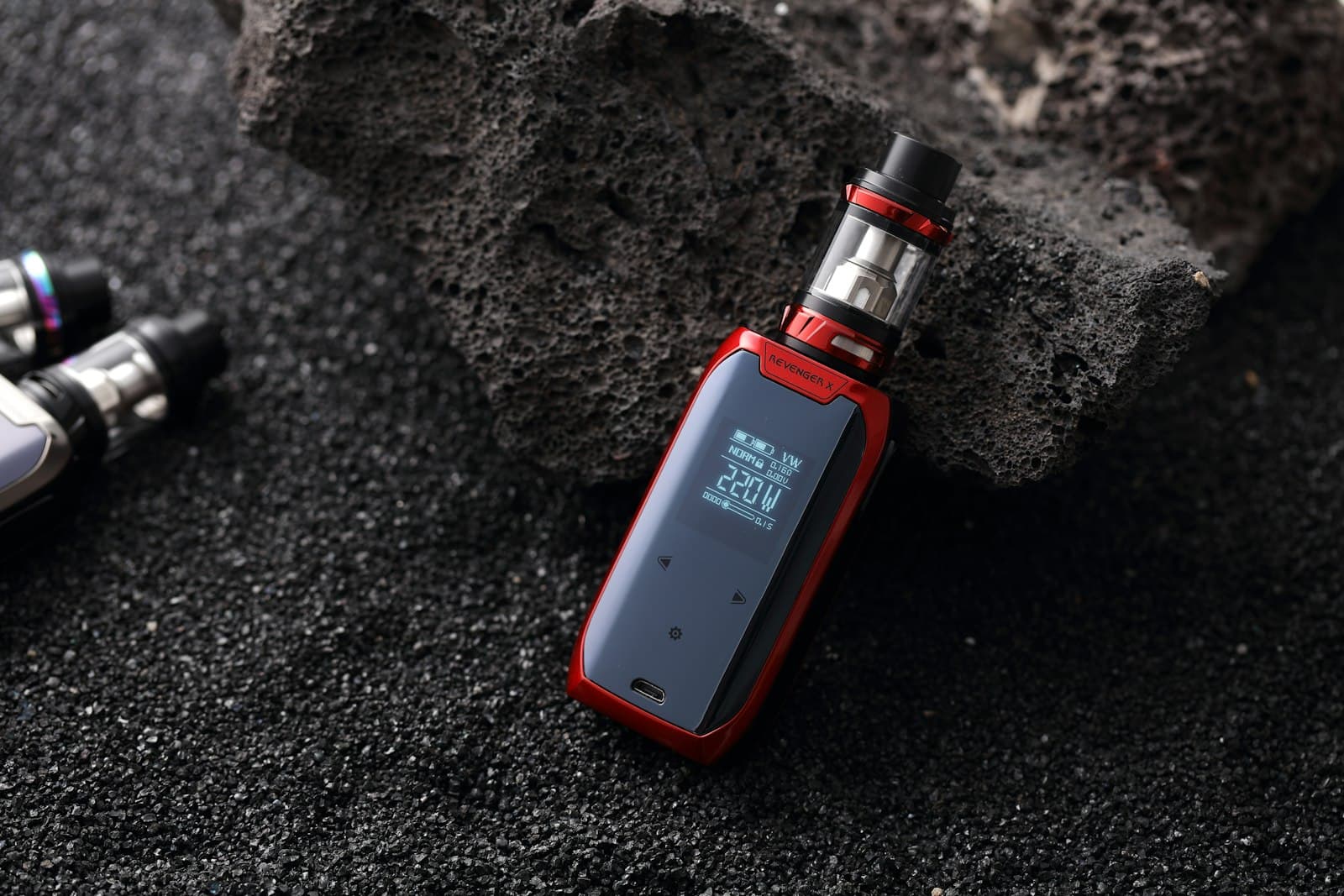
Adjustable airflow control, usually labelled AFC on a tank or pod, is one of the few purely mechanical features left on an otherwise chipset-driven device. It does not change wattage, resistance or battery output. What it changes is how much air mixes with vapour on the way to your mouth, and that single mechanical adjustment affects draw resistance, flavour intensity and how warm or cool the vapour feels. This guide sets out what actually happens when you open or restrict an airflow ring, without claiming one setting is objectively correct.
How an airflow control ring or switch works
Most tanks and pods control airflow with a rotating ring, sliding switch or small dial positioned around the base of the tank or the side of the pod, aligned with one or more intake holes cut into the housing. Turning or sliding the control lines up an open section of the ring with those intake holes, widening or narrowing the gap that incoming air has to pass through before it reaches the coil. On tanks that allow it, fully closed blocks the holes almost entirely; fully open exposes them completely. Some pod kits use a simpler two- or three-position switch rather than a stepless ring, giving fixed presets instead of continuous adjustment. Sealed, cartridge-style pods often have no adjustable airflow at all, since the intake is fixed at the factory.
Single-hole versus multi-hole intake designs
The number and shape of the intake holes themselves also affects the draw, separately from how far the ring is opened. A single large intake hole tends to produce a more directional, sometimes slightly whistly pull, while several smaller holes spaced around the base tend to spread the incoming air more evenly, producing a smoother, less turbulent draw at the same effective opening size. Some sub-ohm tanks combine both approaches with dual or triple intake slots that can be adjusted independently on more advanced designs. None of this is standardised across brands, so two tanks set to a similarly “half open” position can still feel different from one another; the airflow ring’s graduated markings, where a tank has them, are only comparable within that specific model.
What opening or restricting airflow changes
The direct, measurable effect of airflow is draw resistance: how much effort it takes to pull air through the device. Restricting airflow narrows the path air has to travel, so you have to draw harder to pull the same volume of air through, producing a tighter, more cigarette-like pull. Opening airflow widens that path, so air moves through more easily, producing a looser, freer-flowing pull. This is a purely mechanical effect of the size of the air gap, not something the chipset calculates, measures or adjusts on its own.
Draw style: MTL versus DTL
Restricted airflow is generally paired with a mouth-to-lung (MTL) draw, where vapour is pulled into the mouth first and then inhaled, similar in feel to drawing on a cigarette. Open airflow is generally paired with a direct-to-lung (DTL) draw, where vapour is pulled straight into the lungs in one motion, closer to a deep breath, and typically produces a larger volume of vapour per puff. Coil resistance is usually matched to draw style too, as covered in our comparison of pod kits and sub-ohm kits: higher-resistance coils tend to suit restricted, MTL-style airflow, while lower-resistance, sub-ohm coils tend to suit wide open, DTL-style airflow.
Effect on flavour intensity and vapour temperature
Restricting airflow concentrates the vapour: less incoming air is available to dilute or cool it as it passes the coil, which typically reads as a stronger-tasting, warmer draw. Opening airflow does the reverse: more air dilutes the same vapour output, which typically reads as a milder, cooler draw with more visible vapour volume but a less concentrated flavour hit. Neither effect comes from a chipset setting, a wattage change or a different e-liquid; it is airflow changing how much ambient air mixes with the same vapour before it reaches you. Because of this, adjusting airflow is often a faster way to settle a draw that feels harsh or uncomfortably warm than reaching for the wattage dial first.
Finding your preferred setting
- Start near the middle of the range rather than fully open or fully closed, then move one small step at a time so you can judge the effect of each change.
- Match airflow broadly to your coil. Higher-resistance MTL coils are generally designed around restricted airflow; lower-resistance DTL coils are generally designed around open airflow. Running a low-resistance DTL coil on a nearly closed setting can feel unpleasantly hot and harsh.
- Re-check your setting after switching e-liquid. A higher-VG liquid behaves differently at the same airflow setting than a higher-PG liquid, so a setting that felt right before can feel wrong after a bottle change.
- Treat a harsh or overly warm draw as an airflow problem first. Opening the airflow slightly is often a quicker fix than lowering wattage, and does not change how the coil itself is being driven.
- Expect a narrower range on pod kits. Most pod kits are built to stay within an MTL-style envelope, so their adjustment range is usually smaller than a fully open sub-ohm tank’s.
Quick reference
| Setting | Draw feel | Typical pairing |
|---|---|---|
| Restricted / closed | Tight, cigarette-like pull; warmer; concentrated flavour | MTL, higher-resistance coils |
| Mid-range | Moderate resistance; balanced flavour and vapour | Either style, hybrid coils |
| Open / wide | Loose, airy pull; cooler; higher vapour volume | DTL, lower-resistance coils |
Airflow is also worth bearing in mind if your device includes a puff counter or coil-life indicator: a longer, looser direct-to-lung puff and a short, tight mouth-to-lung puff are often logged identically by the chipset, even though they draw very differently on the coil. Our guide to puff counters and coil-life indicators explains why that on-screen figure is a rough guide rather than an exact measurement.