How nic salt strength interacts with your device's wattage and airflow
Last updated 27 September 2026
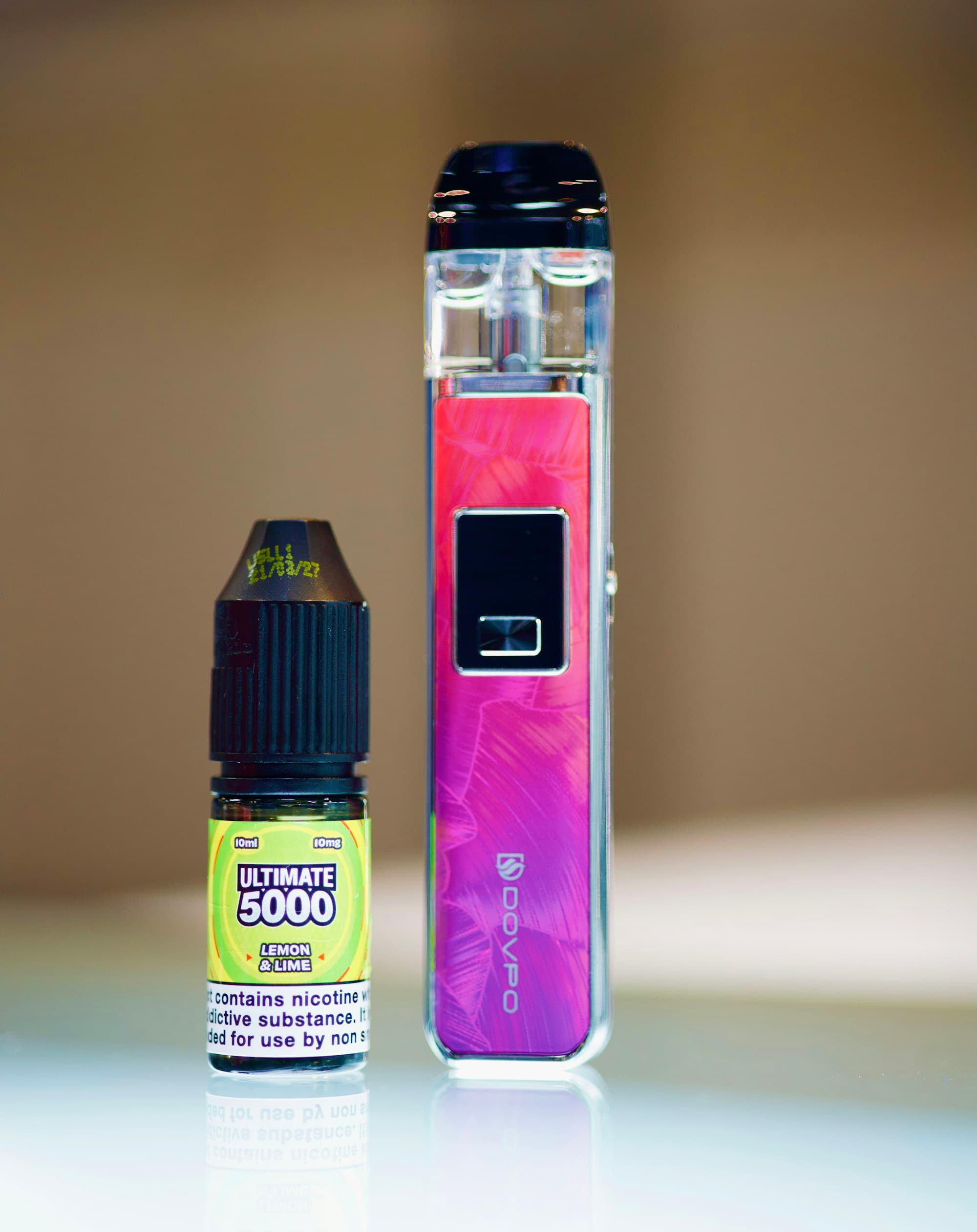
Nicotine salt e-liquid and freebase e-liquid are not only different chemically; on most devices they end up run at different power settings entirely, and mismatching the two is a common reason a setup feels wrong before a vaper even considers changing strength. This guide sets out, factually, why nic salts are typically vaped at lower wattage than freebase or high-VG liquid, how restricted airflow pairs with that lower-power approach, and how nicotine strength choice interacts with both settings to change throat hit and vapour output. None of this is a claim about which strength or setup is “right” for any particular reader — nicotine needs and sensitivity vary from person to person — it is a read of how the mechanics of wattage, airflow and strength line up on a spec sheet.
Why nic salts are generally run at lower wattage
Nicotine salt e-liquid uses a protonated form of nicotine rather than the free-base form used in standard e-liquid, a formulation difference that is widely described as allowing higher nicotine concentrations to be inhaled with a comparatively smoother throat hit than the same strength in freebase form. That characteristic is a stated formulation property, not a health claim, and it is the main reason nic salts caught on for pod devices: a small, low-power pod chipset can deliver a satisfying nicotine hit without needing the higher wattage a freebase or high-VG liquid generally needs to vaporise properly and produce a comparable cloud. Pod kits built around nic salts commonly sit in a roughly 5–25W chipset range, while sub-ohm devices built around freebase or high-VG shortfill liquid commonly run from around 40W up past 200W. Our comparison of pod kits and sub-ohm kits sets out those two wattage bands, and the hardware built around each, in more detail.
Running nic salt liquid at sub-ohm-style wattage is generally not recommended by e-liquid manufacturers: higher power vaporises more liquid per puff, which increases the amount of nicotine delivered in a single draw on top of an already smoother-feeling, higher salt-nicotine strength. That combination is why nic salt bottles are formulated and marketed around the low-wattage MTL pod segment specifically, rather than as a general-purpose option across every device category.
Airflow restriction and the MTL pairing
Wattage is only half of the picture; airflow setting is the other. Restricted airflow narrows the path air has to travel through a pod or tank, producing a tighter, more cigarette-like mouth-to-lung (MTL) draw with a smaller puff volume, while open airflow produces a looser, higher-volume direct-to-lung (DTL) draw. Our guide to what adjustable airflow actually changes covers that mechanic in full, but the relevant point here is that nic salt e-liquid is generally formulated around the smaller, more concentrated puff that restricted MTL airflow produces. A higher-strength nic salt taken in small, tight-airflow puffs stays within a manageable range for many vapers in a way that the same strength pulled through wide-open, high-volume DTL airflow generally would not, simply because open airflow and higher wattage both increase how much liquid is vaporised per puff.
This is also why sealed, low-wattage pod kits are so often built with a fixed or only lightly adjustable airflow, rather than the wide-open rings found on sub-ohm tanks: the whole device, from chipset wattage to airflow intake, is generally engineered around the same restricted-draw, nic-salt-friendly profile rather than left open for a user to dial into DTL territory.
Strength choice: how 5mg, 10mg and 20mg fit into that picture
UK nic salt ranges are typically sold in 10ml bottles across three common strengths: 5mg, 10mg and 20mg, with 20mg/ml the regulatory ceiling for nicotine-containing e-liquid under the Tobacco and Related Products Regulations (TRPR), detailed on GOV.UK. Elux’s nic salt range is a fairly typical example of that structure: 10ml bottles in a standard 50/50 PG/VG formulation (a ratio widely used for nic salts because it suits low-power MTL pod coils without clogging them), priced at around £2.49 a bottle, with roughly 50 flavours available at 10mg and 20mg and a smaller range of around 20 flavours specifically at 5mg. If you’re looking at a lower-strength starting point, Elux vape liquid 5mg is a widely stocked example of that end of the range, though strength choice ultimately comes down to what an individual vaper finds manageable rather than a figure this site can set for you.
At a fixed low wattage and restricted airflow, moving up through 5mg, 10mg and 20mg mostly changes how much nicotine is delivered per puff, without changing puff volume or vapour density much at all, because those are governed by the wattage and airflow settings rather than the strength printed on the bottle. Where the three settings interact is at the edges: a 20mg nic salt run through a pod kit set near the top of its wattage range with airflow opened up will generally deliver both a bigger puff and more nicotine at once than the same bottle at a lower wattage and tighter airflow setting. Many vapers who find a given strength harsher or stronger than expected are actually changing two variables at once — strength and device settings — without realising it; if a 20mg salt feels too strong on a fairly open pod-mod hybrid, tightening the airflow and dropping the wattage before assuming the strength itself is the problem is generally a reasonable first step. Equally, if you find higher strengths give a stronger throat hit than you’re looking for even at a low, restricted setting, a lower strength such as 5mg may suit you better — but nicotine needs vary from person to person, and this is not a recommendation for any specific reader.
Quick reference
| Nicotine strength | Typical device pairing | Typical airflow setting |
|---|---|---|
| 5mg | Pod kit or pod-mod hybrid, lower end of MTL wattage range | Light to moderate restriction |
| 10mg | Standard MTL pod kit | Restricted (typical factory setting) |
| 20mg | Standard MTL pod kit, low end of wattage range | Fully or near-fully restricted |
None of these pairings are fixed rules a chipset enforces; they describe how nic salt e-liquid, pod hardware and UK strength options are generally sold and used together, based on published formulation characteristics rather than in-house testing on our part. Treat wattage, airflow and strength as three settings that interact rather than three separate decisions, and checking a device’s wattage range and airflow adjustment alongside the strength on the bottle is a more reliable way to predict how a combination will feel than looking at any one figure in isolation.